
Completion of ADM 106 Project
See the booking form for the Seminar at Kew to celebrate the completion of the ADM 106 project:
All the world in 1,019 boxes: ADM 106 and the Navy Board
Wednesday 20 November 2019: 1.00–4.30
The National Archives
Bessant Drive
Richmond TW9 4DU
Dr Ann Coats
6 October 2019
In June 1998 the Society agreed to continue a project begun by Richard V. Saville at the Public Record Office in the 1970s. His thesis, ‘Some aspects of the rôle of the Government in the Industrial Development of England, 1686-1720‘ (DPhil, University of Sheffield, 1978), was a principal advance in categorising dockyard jobs. The project improved access to part of the ADM 106 documents at the Public Record Office (now The National Archives). This collection of Navy Board papers includes many runs of correspondence, about a quarter of which are in-letters to the Navy Board, labelled Miscellaneous, from dockyard commissioners, officers and workers, naval captains and contractors from around the world. The project also covers out-letters in ADM B and ADM BP from the Board to the Admiralty, held at the National Maritime Museum, Greenwich. The aim is to improve a very minimal finding aid, which lists bundles of correspondence arranged chronologically, by letters of the alphabet. By 1999 TNA had produced an online catalogue consisting of a database which could be interrogated, so every letter in the bundles (or in the case of ADM B at Greenwich, bound volumes) could be précised to include subjects and the names of people and ships. Researchers may access and interrogate the database electronically for both the documents held at Kew and at Greenwich. In the online catalogue the Greenwich documents are to be found as ADM 354 (ADM B) and ADM 359 (ADM BP).
By July 2013, 239,000 letters had been completed (some 56% of the entire project). The years in the catalogue comprise all but nine documents of the 1730s and 1740–1, 1744–1776, 1780–2 and 1785–7. ADM B (search for ADM 354) and ADM BP (search for ADM 359) were finished in the former Caird Library at the National Maritime Museum Greenwich before the Olympics closed it down. ADM 354 and 359 cover much the same period but do not cover all the years. They do however cover some of the years not covered by the Navy Board Project, up to 1832 when the Navy Board ceased to exist. The letters in these two classes are distinguished by foliation, which does not yet appear on the documents at Greenwich. If anyone locates a useful document held at Greenwich from the catalogue, they need to make a note of the letter by its date and the date of the covering letter, if it is an enclosure, in order to find it at Greenwich, until such time the documents there have the folio numbers applied.
More than twenty volunteers have worked across the two sites and currently the eight at Greenwich are hoping to begin a new project on the correspondence in ADM A in the new version of the Caird Library. In the fullness of time we hope this will also be made available on TNA website. We now have sixteen volunteers working at Kew. Among routine matters found in the letters are requests for stores, the movement of transports, superannuation, surveys, embezzlement and wages, are unique events such as the mutiny of the ropemakers in 1675 and the fire at Portsmouth in the 1770s. There are also many trials of new techniques and equipment, copper plating, air pipes, pumps, distillation of seawater, medicines and inventions. There are constant requests to improve conditions in the yards and the development of yards overseas, including the difficulties of the Surveyor General of HM’s Woods in America. This is an invaluable source for students of naval dockyards, technology, society and administrative history.
Susan Lumas (July 2013)
In November 2013 we are now a team of 16 volunteers, comprising 2 packers and 14 editors. Although we still have not quite finished the period 1730–1789, most of the conservation work has been completed for the period 1742–1743.This means we should be able to tackle the listing of these documents next year, with the remainder of the 1670s and 1780s (32 documents plus about 16, which need to be finished or listed entirely of the conserved documents). Work is mainly concentrated on the 17th century with nearly all of the1670s and 1690s assigned, but unfortunately work has been slow because 7 of the editors are new to 17th century handwriting.
We have tackled the 1690s before the 1680s; the former being a much larger decade (138 documents) and the 1680s comprising only 48 documents. Two editors are working on the remainder of the 1670s; the first three years, 1673–1675 are being reworked because modern computer access requires more keywords than those provided on the 1970s listing of that period, and the year 1679 still needs to be completed. Nearly all of the 1690s, with the exception of 2 years, are already assigned, while 18 documents for 1696 were completed and uploaded some time ago by Gillian Hughes.
Our TNA deadline for completion of the project is 2016 but I doubt at present rate we will be able to complete ¾ of the whole (1,018) documents within that time. I also feel the project should be extended after that date to include the four following decades up to 1832, but we will have to submit as a new project in 2016. Now that we have dedicated packers, the packing for our project will completed before the end of 2016 and can be continued to cover the later four decades.
It is intended to experiment with outside editors working in digitised records. It is not yet set up but perhaps will begin in 2014. We also need to do a survey of all correspondence for the years in the period we have covered already, to discover whether other runs of correspondence duplicate or shed some light on the arrangement in which we find the documents. The sorting of letters by alphabetical bundles is unique to this set of documents and it is unclear as to why it as done this way. It does mean that it is impossible to determine whether we have a day to day correspondence for each yard or each that occurs. This is not something that is part of the original remit for the project but I think it needs to be done in light of our experience of listing.
Susan Lumas (November 2013)
In February 2014 the Project is gradually moving along. This year I hope to finally complete the work on the damaged documents in 1742 and 1743 but there are one or two access hurdles to jump first. We also hope to complete very nearly all of the outstanding 1730s and 1780s and I should finish the 1770s by Easter. Work on the 1670s continues steadily and the work on the 1690s is where our main concentration lies. It is the largest decade after the1740s and is quite a challenge. Out of area volunteers are being recruited to work online. They will start on the 1720s as that decade has not yet been started.
I feel the need for an analysis of the contents of the period of the project, since the Miscellany disguises the coverage of the subjects it contains. Perhaps it would be useful to assess whether we have all the correspondence from the Commissioners and Officers of the yards. I seek an opinion on this.
Finally, in the later period for 1790–1832, these have been separated out so a listing is not so essential. If we do assess the subjects contained in the project – do we expect the readers to find out for themselves or would it be useful to give them a rough idea?
Susan Lumas (February 2014)
November 2014: We now have 17 volunteers at Kew enjoying 17th century handwriting. We also have 2 packers who keep ahead of us and someone who analyses the coverage of dockyard correspondence but I have had no progress report from her yet. Likewise have had no feedback on those recruited to work offsite. Four NDS members have volunteered to help online.
Bruno Pappalardo of TNA has distributed work but the piece number being worked on is somewhat of a pilot study which I have to correct, so I cannot report any progress. Project progress is about 52.5% of ADM 106, excluding work at the Caird. The upload of finished material takes place shortly after the corrections are done so the long time for the end product to be visible is caused by the considerable time it takes to process each document.
I believe the average work done each day is 30 folios by each volunteer for the day they are in; I hope this will increase in time. The latest 6 recruits are still on learning curve but seem enthusiastic.
Susan Lumas (November 2014)
November 2015: There are now 23 of us working on the project and it has been confirmed that our deadline is now the end of 2016, not Easter as we had feared.
We have now finished about ½ of the 17th century and Conservation has finally found time to repair the 1742 documents suffering from mould. We have not listed them yet but we will clear them before too long. We still await the 10 damaged documents in 1743 but they are on their way and by the end of next year 16 documents never seen before will be available to the public. We also still have to finish 4 documents in the 1780s. After that half the project will be complete. We are also just beginning work on the last three decades 1700–1729, which will be done in a more abbreviated form to try and meet the deadline.
The survey of the coverage of the dockyard correspondence is still not complete but I hope to have a more accurate report on whether all months for all years for all yards exist in the Miscellaneous correspondence. Sue reported that she will propose to TNA that the last four decades of NB correspondence (1789–1832) be done as another project. Bruno is planning an Admiralty project.
Susan Lumas (November 2015)
November 2016: We have just won a further extension for the project until March 2018, thanks to Bruno Pappalardo’s bid for more time. He did this by reasoning that we were so close to the end there would be no point in abandoning it now. He asked anyone who had benefitted from the project in some way to report how they had done so. One of the replies he had was from someone researching Lascars, who said she would not have been able to locate them without the project. I certainly have encountered several references to Lascars and their problems in getting paid before they were sent home. This means he will delay the bid for his project on ADM 1 until next year’s negotiations. However, we will not get another extension and we have to finish by March 2018, by which time I hope to actually retire!
This sounds as if we have plenty of time but it will soon pass. We have yet to finish 16 more boxes of the 1670s, 21 more of the 1680s, 2 of 1784, 11 of 1743, which have now been repaired, and 43 of the 1690s – not to mention 276 of the period 1700 to 1729, which is going to be achieved by much shorter catalogue entries.
We have done a pilot study of the shorter entries to speed them up, which should assist people trying to locate something in that period more than they can now, but which will not give them quite so many detailed options to interrogate the catalogue. By concentrating our endeavours on the 17th century, using 11 volunteers, we may be able to complete the century by August of next year. This will leave us 7 months to put all hands on the final three decades. Some volunteers have already said they will put in more time if needed. This is not the time to add more volunteers as they take about 6 months to train, when I could be working on a document but we may do so on the simpler version if they are required.
Susan Lumas (November 2016)
Navy Board Project at The National Archives (TNA) is extended for another year
At its 1999 AGM the Naval Dockyards Society agreed to support Sue Lumas’s proposal for a project listing ADM 106 at the Public Record Office. This ‘valuable collection’ (D. Baugh, Naval Administration in the age of Walpole (1965), 537) of Navy Board in-letters 1658–1837 comprises miscellaneous correspondence from dockyard commissioners, dockyard officers, naval captains, dockyard contractors and dockyard workers from around the world.
Of the 1,019 boxes of correspondence in ADM 106/281-1299, 881 boxes have been catalogued to date and are searchable on Discovery, TNA online catalogue. Fewer than 100 boxes remain to be processed. Note: each box can contain up to 500 individual letters.
The Navy Board Project (NBP) was one of the first TNA volunteer projects to be linked to another archival collection. Listing of ADM 106 at Kew was soon joined by the volunteer listing of Navy Board out-letters to the Admiralty, 1738–1809, at the Caird Library, National Maritime Museum Greenwich. ADM/B and ADM/BP at the National Maritime Museum are searchable on TNA Discovery as ADM 106/354 and ADM 106/359 respectively.
The NBP was due to end on 31 March 2018, but at the wish of the AGM, the NDS wrote to the TNA Catalogue Panel and User Participation Boards to request them to reconsider the deadline, as completion was so close. This week the NDS heard that the TNA User Participation Board, in recognition of the efforts, progress made and the commitment of the team over the last year in some challenging circumstances, has agreed to grant the NBP a final extension of one year to complete the project.
Our letter was supported by:
Chris Donnithorne, Naval Biographical Database, http://www.navylist.org/ :
The value of the Navy Board Project is in identifying previously unknown material, and the care with which the process has been undertaken – it is reliable. This does not, of course, insure against error in the original source (thankfully relatively rare) but it does help significantly when faced with a plethora of websites which look terrific but tend to fail miserably when tested against the primary sources.
and Chatham Historic Dockyard Trust Researchers,https://sites.google.com/site/chdtresearchers/
The research group for Chatham Historic Dockyard Trust has made extensive use of the thorough indexing of ADM 106 Navy Board Correspondence. It has enabled us to understand the systems and practices used by the Royal Navy and Royal Dockyards in a fuller and richer way. It helps us produce much richer biographies for individuals we have been researching. Importantly, it helps us cover a wider social/economic range more fully, expanding beyond commissioned officers to provide lots of material on warrant officers and senior dockyard artisans, as well as illuminating material on a significant proportion of lower ranks and tradesmen.
We thank TNA User Participation Board for their consideration, the Principal Record Specialist Manager at The National Archives for military, maritime and transport records and all the volunteers who have contributed their time to the NBP since 1999. But above all we thank Sue Lumas, its driving force and coordinator. The NDS will collaborate in an event to mark the completed project, to celebrate its valuable work in enabling global dissemination, research and publication of this key data for administrative, maritime and cultural history.
To illustrate the importance of this project and the documents thus produced, an example is shown below which is a Discovery entry for ADM 106/330/496, 1678 Dec 5:
Commissioner Sir Richard Beach, Chatham. Is sending a rough draft of the River, with an explanation of the numbers indicated on the plan and the defences proposed. St Mary’s Creek, the the platform at Gillingham, Upnor Castle, Cockram Wood and the yard are marked on the plan. A sentinel is also required at Faversham and a platform should be built on the site of Queenborough Castle and a 4th rate moored at Queenborough creek. Warning should be sent from Faversham and fire ships should be ready at Sheerness. He apologises for the quality of the plan but his sight is failing.
This entry leads to a very significant document in the aftermath of the Dutch Raid on Chatham 9–23 June 1667. This action, which began when Admiral de Ruyter and his fleet arrived in the Thames estuary on 9 June, ended the Second Anglo-Dutch War (1665–67).
To save money in 1667, Charles II had ordered the fleet to be laid up in the Medway anchorage, ostensibly protected by a new Sheerness fort, river batteries and a boom. However, Commissioner Peter Pett failed to carry out his orders. The great ships had not been moved upriver and Sheerness Fort was incomplete. The fort was seized on 10–11 June with an amphibious force of ships and marines, threatening Chatham Dockyard. The Dutch breached the chain and burnt Mary, Royall Oake and Loyall London. At the last minute, ships sunk near the Medway riverbank in Dockyard Reach and the presence of large guns, cavalry and infantry deterred the Dutch advance beyond Upnor Castle. Chatham Dockyard was spared. Nevertheless, the capture of Royal Charles and loss of nine other warships, plus earlier battle losses, represented a shocking humiliation for the king and the country. The Raid effectively ended the war by forcing Charles II to sign the Treaty of Breda. The Dutch only left the Thames Estuary when the English signed the Treaty on 21 July (31 July in the Netherlands).
Ten years later, when the navy was reviewing its strategy, Chatham Commissioner Sir Richard Beach sent his plans to strengthen Medway defences against future attack, accompanied by a key (see below the map)
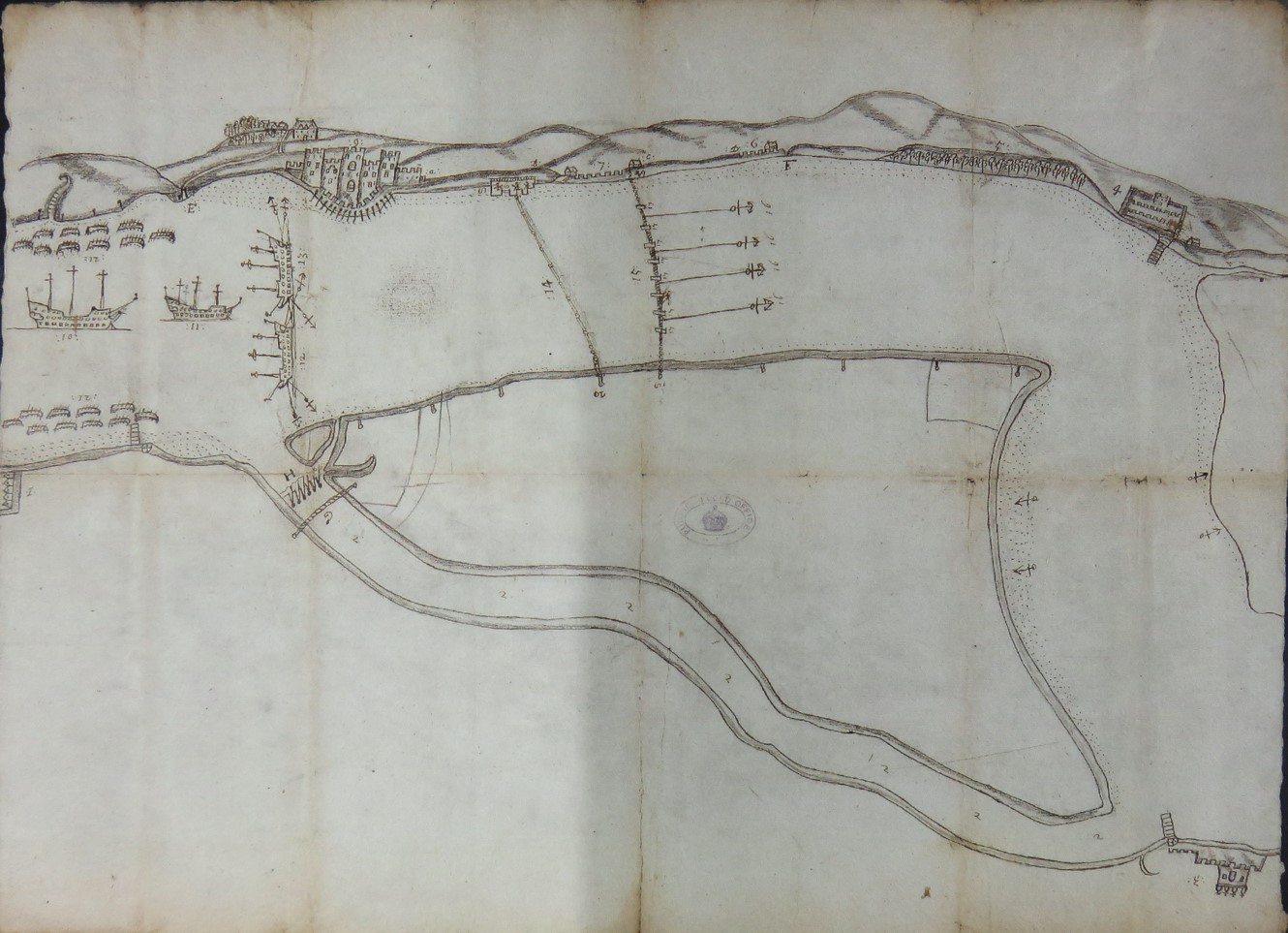
Chatham Commissioner Richard Beach’s map of his Proposal re. Cables, 1 November 1678, TNA, ADM 106/330, ff. 495-497.
Image by A. Coats, courtesy of The National Archives, Kew
A rough draft of part of this river with my opinion how it should be fortified against the Attaques or attempts by a fforreigne Enemy
- Chatham Yard
- St Mary Creek
- The platform at Gillingham
- The platform at the lower end of Cookram Wood
- Cookram Wood
- The Birds Nest in which are 18 Guns
- The platform next the Castle wherein are 12 Guns
- The wharf wherein are 3 Crabs for heaving taut the Boome or Chaine
- Upnor Castle
- One of His Majesty’s Ships
- Another Ship
- )Two ships moared with their broadsides towards the Chain
- ) to rake any ships that shall come up the Reach fore & aft
- The Boom or Chain
- Two cables which I would have seased together
- and a chain at each end, as at 18 and 19
- Pieces of Mast or Great Balks to be seased to the upper part of the cable with small chains
Dr Ann Coats
14 April 2018
 Naval Dockyards Society